The numbers are staggering: $547 billion spent on AI in 2025 that delivered zero business value. Research from RAND, MIT, and McKinsey paints a pretty bleak picture: 80% of AI projects fail (twice the rate of regular IT projects), 95% of pilots never make it to production, and 42% of companies abandoned most of their AI initiatives in 2025, up from 17% the year before.
If you're not caught up in the hype, this probably isn't shocking. If you are, it should be.
Who's Wasting the Money
The companies contributing to that $547 billion bonfire share a few things in common. They picked the technology before they identified the problem. They hired consultants who sold them complexity, because complexity is what consultants get paid to deliver. They built agents and "AI transformations" when what they actually needed was an if/then statement.
Most of the waste is coming from companies that jumped on the AI bandwagon without really knowing what they wanted to accomplish. They heard the buzz, got nervous about being left behind, and started spending, with no clear definition of what AI was supposed to do for them.
What Experienced Companies Are Doing Instead
The experienced companies not contributing to that waste, the ones who've been doing custom development and automation for years, looked at AI the way they look at every new tool: "Cool. Here's where it fits into what we're already building."
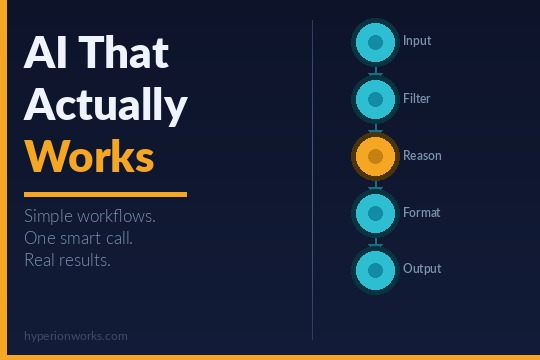
Not agents. Not chatbots. Boring, deterministic workflows with one well-scoped LLM call in the places where actual reasoning is needed. Custom code on top of a database, doing exactly what it's supposed to do. Nothing more, nothing less.
Think about a workflow that's 90% predictable logic. You don't need AI for the predictable parts. You need clean, reliable code. You only need AI for the small percentage of that workflow that genuinely requires interpretation: understanding a customer's intent from an unstructured message, summarizing a document, making a judgment call from incomplete information. Put AI there. Make everything else deterministic.
The Question That Changes Everything
Every successful technology project starts with the same question: what problem are we solving? Not "how can we use AI?" but "what problem are we solving?" If you can answer that clearly, you can figure out whether AI is the right tool. More often than not, you need a workflow that should have existed years ago, with one smart call in the one place it actually adds value.
It's worth noting that 73% of failed AI projects had no clear success metrics going in. That's not an AI problem. It's a project planning problem that would have sunk any initiative, AI or otherwise. If you can't say "this project succeeds when X happens," you're not ready to build it.
Where to Start
If you're trying to figure out where AI might genuinely help your business, start here: find the task your team does repeatedly that follows a mostly predictable pattern but occasionally requires a judgment call. That's your candidate. Automate the repetitive logic with standard code. Apply an LLM to the judgment call. Only the judgment call.
If you're already deep in an AI initiative that isn't delivering, the fix is usually the same: scope down, remove the complexity, and identify the specific place where reasoning is actually required. Start there and work outward.
We've helped clients find this kind of focused, practical answer. If you'd like help cutting through the noise and figuring out what would actually work for your business, give us a call.